Global South Country Information (Zoom in and click on the Country)
Early Warning for All (EW4ALL) Global Framework
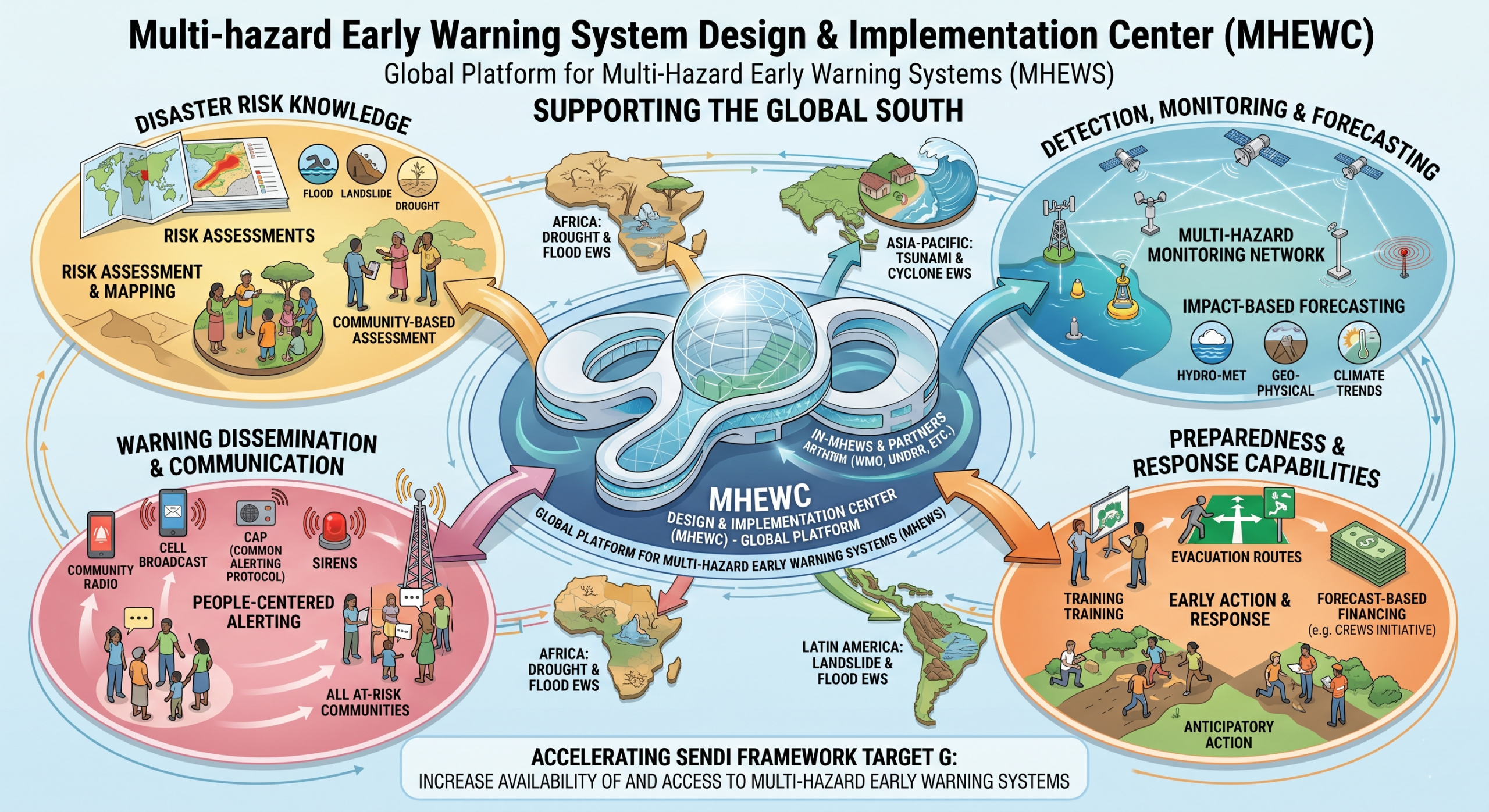
The Multi-Hazard Early Warning System Design & Implementation Center (MHEWC) is envisioned as a global platform advancing the research, design, development and implementation of disaster risk management (DRM) decision-support systems (DSS); end-to-end hydrometeorological multi-hazard early warning systems (MHEWS); and integrated approaches to climate-risk management, risk-informed adaptation, mitigation, and resilience building. Its primary focus is on strengthening capacities and supporting implementation in countries across the Global South.
Currently at an early stage of development as a voluntary initiative, MHEWC recognizes the technical, institutional, and operational complexity of establishing effective MHEWS. The Center aims to support the deployment of new systems, assess existing operational capacities, and upgrade country-level platforms into fully functional, interoperable and integrated online systems.
Through its geospatially enabled platform, MHEWC seeks to strengthen coordination and information exchange among agencies responsible for climate-vulnerable sectors, stakeholders, value-chain actors and frontline communities. By connecting these actors within a unified framework, the platform would support coordinated hydrometeorological service delivery, linking operational forecasting, sector-specific impact-based forecasting, standardized alerting, and real-time event updates.
Ultimately, MHEWC aims to advance ICT-enabled local risk governance by equipping sector departments to conduct multi-hazard exposure, risk and vulnerability assessments; establish and maintain risk-information repositories; and improve data exchange across institutions and administrative levels. These capabilities would enable tailored risk-information services that translate technical knowledge into actionable guidance for local planning, preparedness, anticipatory action, and climate resilience.
Services Offered by MHEWC:
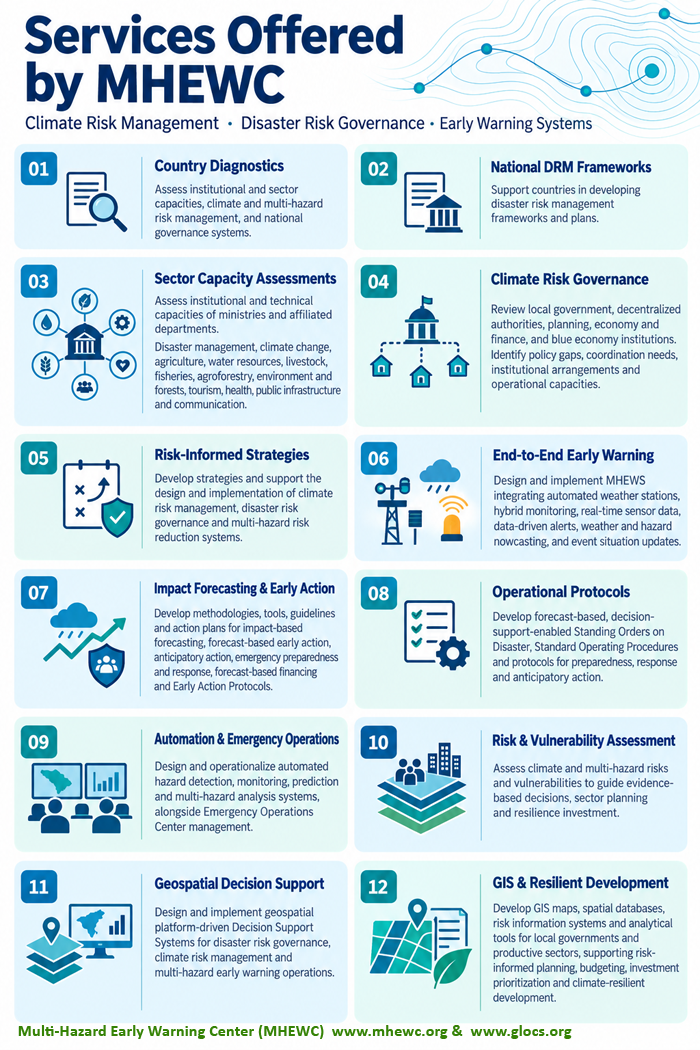
- Conduct country-level institutional and technical assessments of sector ministries and affiliated climate-vulnerable departments, including Disaster Management, Climate Change, Agriculture, Water Resources, Livestock, Fisheries, Agroforestry, Environment and Forest, Tourism, Health, Public Infrastructure, Communication, and other relevant sectors.
- Assess national climate risk governance systems by reviewing relevant local government and planning institutions, including ministries responsible for local government, decentralized local authorities, development planning, economy and finance, and blue economy. This will include identifying institutional arrangements, coordination mechanisms, policy gaps, and operational capacities related to climate risk management, multi-hazard disaster risk governance, and resilience planning.
- Develop robust strategies and support the design and implementation of informed climate risk management, disaster risk governance, and multi-hazard risk reduction systems.
- Design and implement end-to-end Multi-Hazard Early Warning Systems (MHEWS), including the installation and integration of Automated Weather Stations (AWS), hybrid weather and hazard monitoring systems, real-time sensor-based data ingestion, data-driven early warning systems, weather nowcasting services, hazard nowcasting services, and hazard event situation update mechanisms.
- Develop methodologies, tools, guidelines, frameworks, and action plans for Impact-Based Forecasting (IBF), Forecast-Based Early Action, anticipatory action services, forecast-based emergency preparedness and response management systems, Forecast-Based Financing (FbF) mobilization, and Early Action Protocol development.
- Develop forecast-based Decision Support System (DSS)-supported Standing Orders on Disaster (SoD), Standard Operating Procedures (SOPs), and operational protocols for preparedness, response, and anticipatory action.
- Design, implement, and operationalize fully automated systems for hazard detection, monitoring, prediction, multi-hazard analysis, and Disaster Emergency Operations Center (EOC) management.
- Conduct climate and multi-hazard risk and vulnerability assessments to support evidence-based decision-making, sector planning, and resilience investment.
- Design and implement geospatial platform-driven Decision Support Systems for disaster risk governance, climate risk management, and multi-hazard early warning operations.
- Develop GIS maps, spatial databases, risk information systems, and analytical tools to support local governments and productive sectors in risk-informed planning, budgeting, investment prioritization, and climate-resilient development.
Designed & conceptualized by Z M Sajjadul Islam, Advisor, MHEWC